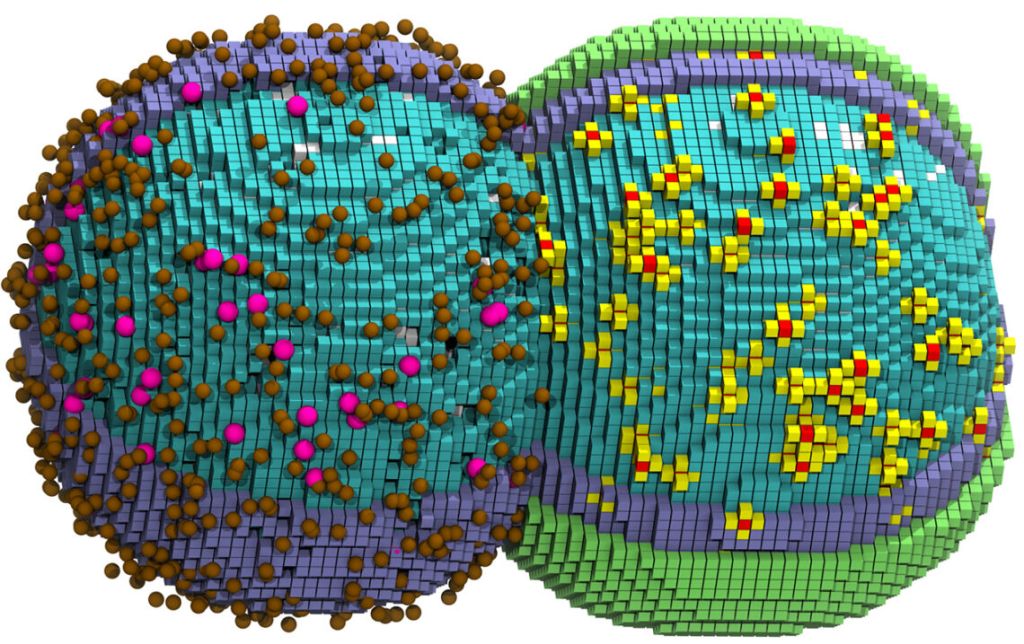
This week, a research team at the University of Illinois Urbana Champaign reported something that used to sound like science fiction: a full life cycle simulation of a living cell, from DNA replication and metabolism to growth and division. They did it for a genetically minimal bacterium, and they did it at nanoscale resolution, tracking how the cell’s molecules behave throughout the cycle.
The trick was choosing the right organism and the right computing strategy. The team used a “minimal cell” called JCVI syn3A, engineered to carry only the genes needed for basic life functions, which makes the modeling problem hard but not impossible. Even so, the simulation still had to account for every gene, protein, RNA molecule, and chemical reaction strongly enough that the timing of cellular events came out close to reality.
What makes the story feel like a real milestone is the engineering detail. One part of the biology, chromosome replication, was so computationally expensive that it almost doubled the runtime. The team ended up dedicating a separate GPU to DNA replication while another GPU handled the rest of the cell dynamics, which is the kind of pragmatic systems decision you only make after you have actually tried to run the whole thing. With that split, they simulated a 105 minute cell cycle in six days of compute time on the Delta supercomputing system at the National Center for Supercomputing Applications.
This is not an atom by atom digital cell, and it is not a replacement for experiments. The point is leverage. A whole cell model that can predict many cellular properties at once is like running hundreds of coordinated experiments in silico, then using real data to keep the model honest and refine it. If this approach scales, it changes what “understanding a cell” can mean, because you can start asking systems questions that are too entangled to isolate in the lab one variable at a time.
Sources: https://news.illinois.edu/team-simulates-a-living-cell-that-grows-and-divides/ https://www.ncsa.illinois.edu/2026/03/10/simulating-the-life-cycle-of-a-cell-with-ncsas-delta/
 Maurizio Morri - Science Blog
Leave a comment